


remove text highlights
How to Get a GED in Maryland
Would you like to earn a higher salary? Are you trying to broaden your career opportunities? Or, maybe you'd just like to be say, "Yes! I have my high school diploma!" Whatever your reason, the State Library Resource Center can help you get your GED.
This guide answers many questions about the GED in Maryland:
What is a GED?
Many people call the GED the "General Equivalency Diploma." But "GED" actually stands for "General Educational Development." The GED is a test developed by the American Council on Education (ACE). According to ACE, "more than 95 percent of U.S. employers consider GED graduates the same as traditional high school graduates in regard to hiring, salary, and opportunity for advancement."
The GED is one of two ways that adults can earn a high school diploma in Maryland.
The GED consists of 5 tests:
- Language Arts, Writing, Part I (50 questions, 75 minutes) and
Language Arts, Writing, Part II (1 essay, 45 minutes)
- Social Studies (50 questions, 70 minutes)
- Science (50 questions, 80 minutes)
- Language Arts, Reading (40 questions, 65 minutes)
- Mathematics (50 questions, 90 minutes)
You take the GED tests over a two-day period. Most parts of the tests are multiple-choice. Both the Maryland Adult Literacy Resource Center and ACE provide detailed descriptions of the GED exams.
To earn your high school diploma, you must score at least 2250 points, with at least 410 points on each of the 5 tests. After you pass all the GED tests, the Maryland State Department of Education will award you your high school diploma.
If you have more questions about the GED, contact the GED Office of the Maryland Adult Literacy Resource Center.
Can I take the GED? Am I eligible?
In Maryland, you can take the GED if you:
- Are at least 16 years old
- Are NOT currently enrolled in high school
- Are NOT a high school graduate
- Have been a resident of Maryland for at least three months
- Have been officially withdrawn from regular high school for at least three months
How to Sign Up
The Maryland Adult Literacy Resource Center has an application (PDF format) that you can print out and mail in. Make sure you read the guidelines for completing the application, located on the third page of the application. Depending on your age and other factors, you may need to include additional forms.
Studying for the GED
Few people can pass the GED without studying ahead of time. Three important ways to prepare are taking practice tests, studying the topics tested by the GED, and taking classes.
Practice tests
Before you start studying or taking classes for the GED, you might want to take a practice test, so you can find out your strengths and weaknesses. As you continue studying, you might want to keep on taking practice tests. This way, you can get used to the pace of the test and see how you're improving.
A practice test usually has the same types of questions you would find on the real GED exam. When you're taking a practice test, it's important to limit yourself to the same amount of time you would have if you were taking the real GED exam.
The State Library Resource Center has several books with practice tests:
- Ronald and Steffi Kaprov's Master the GED. Lawrenceville, NJ : Peterson's, Annual. (Job and Career Information Center - LB3060.33.G45 K37Q).
- Patricia Mulcrone's McGraw-Hill's GED: The Most Complete and Reliable Study Program for the GED Tests. Chicago: McGraw-Hill, 2002. (Job and Career Information Center - LB3060.33.G45M34 2002Q)
- Princeton Review Cracking the GED. New York: Villard Books, 2007 (Job and Career Information Center - LB3060.33.G45P75Q 2007)
- Si usted necesita un libro en español, nosotros tenemos Master the GED en Español (Job and Career Information Center - LB3060.33.G45S47Q).
Not only do these books have full-length practices exams, but they also offer in-depth review and study tips.
You can also take practice tests on the Internet:
- 4Tests.com: GED. This site provides free practice tests for the GED. You must register in order to use this site.
- GEDpractice.com. This site, sponsored by Steck-Vaughn, offers practice modules for GED students and is available for free, although registration is required.
- Learning Express Library. If you have a card that is registered with the Pratt Library, you can enter this site through the State Library Resource Center's database homepage. At the database homepage, go to the "College and Career" category, and click on "Learning Express Library." From there, you can register as a "new user" and use the "GED Preparation" site. You must have a card that is registered with the Enoch Pratt Free Library to use the site.
Studying the Topics Tested by the GED
How the State Library Resource Center Can Help
Here at the State Library Resource Center, you can find a broad assortment of resources to help you in preparing for the GED exam. Here are some examples of useful books, videotapes, and Web sites:
Books
- Our American Government. Washington: US Government Printing Office, 2000. JK274.O95 2000. (Social Science and History Department) This booklet includes the Declaration of Independence, the Constitution and its amendments, and information about the branches of the United States government.
- Steck-Vaughn GED: The Essay by Myra Baum. Austin, TX: Steck-Vaughn Co., 1996. PE1065.G45A74 1996Q. (Humanities Department) This book contains useful advice and practice for composing the essay, which is required on Part II of the Language Arts: Writing test.
- Steck-Vaughn GED: Writing Skills by Myra Baum. Austin, TX: Steck-Vaughn Co., 1996. LB1631.S73 1996Q. (Social Science and History Department) This concentrates on Part I of the GED Writing Skills test. It provides a comprehensive review of English grammar, usage, and sentence structure.
- Essential Mathematics for Life by Mary S. Charuhas. New York: Glencoe, 1995. QA107.E86 1995Q. (Business, Science, and Technology Department) This series includes workbooks for decimals and fractions, percents, algebra, and other math topics.
- Biology The Easy Way by Gabrielle I. Edwards. Hauppauge, NY: Barron's Educational Series, 2000. QH307.2.E38 2000Q. (Business, Science, and Technology Department) If science is your weak spot, try this crash course.
- Out of Many: A History of the American People by John Mack Faragher and others. Englewood Cliffs, NJ: Prentice-Hall, 1994. E178.1.O935 1994Q. (Social Science and History Department) Volume 1 covers American History up through the Civil War. Volume 2 covers Reconstruction through the present.
- Chemistry The Easy Way by Joseph Mascetta. Hauppauge, NY: Barron's Educational Series, 1996. QD41.M381996Q. (Business, Science, and Technology Department)
- Contemporary's GED Test 3: Science by Robert Mitchell. Chicago: Contemporary Books, 1994. JOB CENTER Q182.M53 1994Q. (Job and Career Information Center) Mitchell's book focuses on the GED Science exam and developing critical thinking skills in science. It features helpful practice exam questions and answers.
- Pocket History of the United States by Allan Nevins and Henry Steele Commager. New York: Pocket Books, 1992. E178.N358 1992. (Social Science and History Department)
Videotapes
- Basic Mathematical Skills. Metairie, LA: Educational Video Resources and Jim Williamson Productions, 1992. (Sights and Sounds Department) This series consists of a dozen videotapes that provide instruction on everything from basic addition and subtraction to solving equations.
- Beginning Algebra. Metairie, LA: Educational Video Resources and Jim Williamson Productions, 1992. (Sights and Sounds Department) This 20-part course covers the basics of algebra and more. It even includes a video explaining how to deal with word problems!
- Grammar Pitfalls. Falls Church, VA: Cerebellum Corp., 2001. (Sights and Sounds Department) Do you need help with subject/verb agreement, sentence fragments, run-on sentences, or contractions? Start with this "Standard Deviants" series. Other videos in this set cover punctuation, verb tenses, and clauses.
- How to be a Superstar Student by Tim McGee. Springfield, VA: Teaching Co., 1994. (Sights and Sounds Department) Tim McGee offers useful advice on how to develop active reading skills and improve your writing. This presentation also looks at organization and time management.
- Algebra I by Monica Neagoy. Springfield, VA: Teaching Co., 1997. (Sights and Sounds Department) This three-part series offers an in-depth look at basic Algebra. The programs include coverage of linear equations, quadratic functions, and polynomials.
- Geometry by James A. Noggle. Springfield, VA: Teaching Co., 1998. (Sights and Sounds Department) Noggle discusses geometric concepts such as angles, polygons, triangles, congruence, and the Pythagorean theorem.
- Basic Math by Murray H. Siegel. Springfield, VA: Teaching Co., 1997. (Sights and Sounds Department) This three-part set covers basic math from A to Z. Individual videos offer discussions on long division, using the calculator, geometry, graphing, and problem solving techniques.
Web Sites
- About: Adult/Continuing Education - General Educational Development - GED
This site will link you to many other sites for useful information on GED preparation services and resources. Several of these links offer good, common sense advice for individuals interested in taking the GED exam.
- American Council on Education - GED Testing Service
This is the official Web site of the GED Testing Service. It offers material on the history of the GED tests as well as statistical data. This site also furnishes answers to frequently asked questions about the GED tests.
- GED Quick Guide for the Classroom
Provided by the National Institute for Literacy, this resource provides links to GED-oriented Web sites that will be useful to teachers as well as students.
- KET GED - Online Professional Development
This interactive resource, prepared by the Kentucky Department for Adult Education and Literacy, focuses mainly on teachers. However, it is a useful site for anyone interested in the GED tests.
GED Classes
Many places offer GED classes, including:
- Public school systems
- Community colleges
- Public libraries
- Youth and family centers
- Literacy groups and other community organizations
Maryland Online GED Preparation Classes
The Maryland Department of Labor, Licensing and Regulation and the U.S. Department of Education now offer a GED preparation class available on the Web. To enroll in the online GED preparation program, you must be a Maryland resident, at least 16 years of age, officially out of school, able to demonstrate minimum 9th grade skills by pre-testing in math and reading at your local Adult Education program, and committed to submitting at least 6 assignments and studying 5-6 hours per week. Taking these online classes allows you to work at your own pace and prepare for all five GED tests.
UMBC's Adult Literacy Resource Center provides a county-by-county list of places where you can take GED classes in Maryland. If you click on the name of the county, you'll find the address, phone/fax number, hours, and cost of GED classes in the area.
Where to take the GED test
There are testing centers throughout the state of Maryland. The Maryland Department of Labor, Licensing and Regulation includes a list of testing centers on page 4 of their online application (PDF file). If you are not from Maryland, ACE offers a helpful GED testing center locator. You can enter your postal code or zip code, and you be provided with a list of centers near your location.
If You Need More Help
This guide should help you find all the answers you need for getting your GED. If you do not live close to the State Library Resource Center, a public library near you should have some of the resources we've mentioned. If you still need help, contact us through our Ask A Librarian Service, call (410) 396-5430, or write:
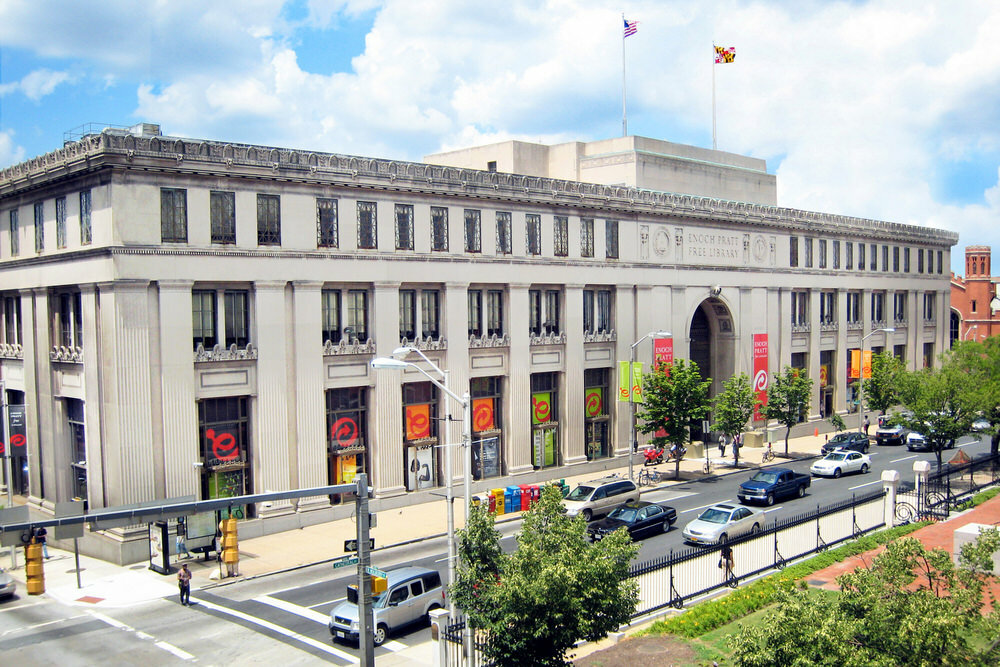
Enoch Pratt Free Library
State Library Resource Center
400 Cathedral Street
Baltimore, MD 21201